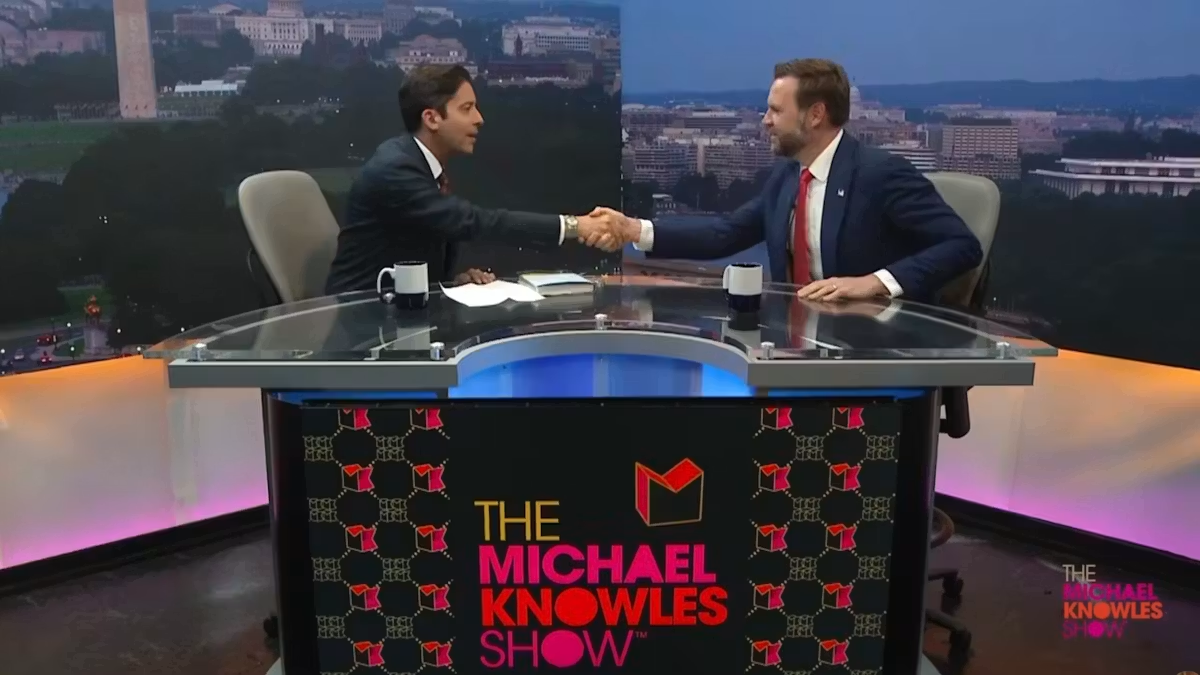
JD Vance Lays Out Post-Trump Conservative Vision In Interview With Michael Knowles
Vice President JD Vance laid out his vision for the future of the Republican Party during a wide-ranging interview with Daily Wire host Michael Knowles released Tuesday, touching on everything from his conversion to Catholicism to artificial intelligence, Iran, and the direction of the conservative movement after President Donald Trump’s second term.
Read more Trump Reveals Host City For First Ever Midterm Convention In September
While much of the conversation focused on Vance’s new book, Communion, and his journey back to Christianity, it also explored the political philosophy guiding one of the GOP’s leading figures.
One of the interview’s biggest takeaways came when Vance declared that today’s Republican Party has fundamentally moved beyond the economic consensus that defined conservatism for decades.
“American economic policy on the right is now much more Alexander Hamilton than it is Milton Friedman,” Vance said, arguing that President Trump’s political movement has already transformed the GOP’s approach to trade, tariffs, manufacturing, and industrial policy.
Rather than viewing economic growth as an end in itself, Vance argued that government should prioritize policies that strengthen families, communities, and workers.
“The economy is a tool to service the dignity of the human person,” he told Knowles.
Vance also took aim at modern meritocracy, arguing that elite institutions have encouraged Americans to pursue achievement for its own sake instead of focusing on what gives life meaning. He contrasted elite careerism with the importance of family, faith, and community, telling Knowles that “nobody is on their deathbed” wishing they had spent less time with their children in exchange for greater wealth.
Knowles also asked Vance about the intellectual influences behind his worldview, prompting discussions of St. Augustine, St. Thomas Aquinas, René Girard, Pope Leo XIII, and Catholic social teaching. Vance credited those thinkers with helping shape both his religious conversion and his political outlook.
Read more Congressman Gone MIA Reveals He Missed 3 Months Of Work Due To Depression
The vice president also reflected on his own conversion to Catholicism, describing his journey from an unchurched evangelical upbringing through atheism before ultimately finding stability in what he called the Catholic Church’s continuity across generations and its unchanging doctrine.
Beyond philosophy, Knowles pressed Vance on several major policy issues. Discussing the administration’s handling of Iran, Vance defended President Trump’s willingness to use military force while rejecting what he characterized as intervention for its own sake.
“The president is willing to drop bombs,” Vance said, “but only if it serves an objective.”
On artificial intelligence, Vance argued that America must remain competitive with China while also preventing AI from becoming a tool for social harm. He distinguished between AI used for breakthroughs like curing disease and applications that promote pornography, exploit children, or concentrate power among large technology companies.
Looking ahead to the 2028 election, Vance predicted Democrats would likely nominate Rep. Alexandria Ocasio-Cortez (D-NY), arguing that universities, rather than labor unions, have become the Democratic Party’s true center of power.
Vance laid out the broader ideas informing his vision for the Republican Party: one centered on national development, family, faith, and what he repeatedly described as the dignity of the human person, arguing those principles should guide the GOP beyond Trump’s second term.
Read more Trump Plans Assault On Birth Tourism After Letdown At SCOTUS
Watch the full interview:










Post Comment