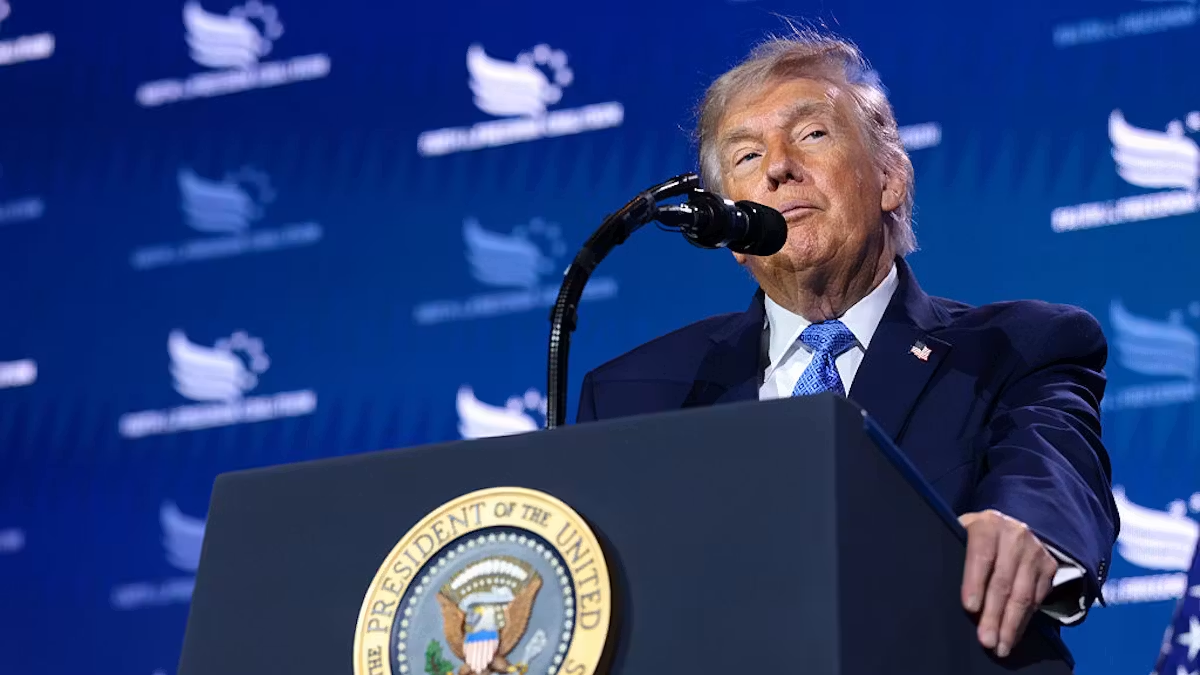
Supreme Court Rules Against Trump In Birthright Citizenship Case
The U.S. Supreme Court on Tuesday permanently blocked President Donald Trump’s executive order seeking to restrict birthright citizenship, dealing a significant blow to his immigration agenda and preventing a sweeping overhaul of who qualifies for U.S. citizenship.
Read more Supreme Court Protects Women’s Sports In Landmark Ruling
authored by Chief Justice John Roberts, the Supreme Court held that children born in the United States to parents unlawfully or temporarily present are “subject to the jurisdiction” of the United States and are citizens at birth under the Fourteenth Amendment’s Citizenship Clause.
“Citizenship, then and now, was the right to have rights — to freely participate in our political community. The Framers of the Fourteenth Amendment extended that promise to ‘every free-born person in this land,’” Roberts wrote. “We keep that promise today.”
Justice Brett Kavanaugh concurred in part and dissented in part. He disagreed with the court’s holding that Trump’s executive order violated the Fourteenth Amendment to the Constitution. Instead, he argued that the order violated other federal statutes, saying only Congress can enact new exceptions to birthright citizenship for children born to illegal immigrants.
Justices Clarence Thomas, Samuel Alito, and Neil Gorsuch dissented.
“The Court has repurposed the Fourteenth Amendment to protect its own set of preferred rights that the Reconstruction Congress never contemplated and that cannot find support in its text,” Thomas wrote. “Today, the Court does so again by recognizing a constitutional right to citizenship for the children of all foreign birth tourists and illegal aliens.”
Tuesday’s ruling ends a dramatic legal saga and campaign promise that could’ve redefined who qualifies for U.S. citizenship ahead of the country’s 250th anniversary. On his first day back in office, President Trump signed the long-promised order, which faced immediate legal challenges and was never implemented. The White House has argued that children born to illegal immigrants or to parents with temporary legal status, such as tourists or foreign students, are not “subject to the jurisdiction” of the United States and not entitled to automatic citizenship.
“The United States of America cannot live with the shackles of Birthright Citizenship. It is not economically, or otherwise, sustainable, and no other Country in the World, of consequence, does it,” Trump said in a June 11 Truth Social post.
Those challenging Trump’s order agreed that “subject to the jurisdiction thereof” sets up limited exceptions for children of foreign diplomats and babies born to enemies during an invasion. Ratified in 1868, three years after the end of the Civil War, the 14th Amendment was adopted in part to guarantee citizenship for formerly enslaved people and their descendants.
Read more How A Detransitioner’s Legal Win Marks ‘Watershed Moment’ For Victims Of Gender Procedures
During oral arguments in April, which Trump attended, the three liberal justices quickly signaled their opposition to the executive order, and Chief Justice John Roberts, along with conservative Justices Brett Kavanaugh and Amy Coney Barrett, expressed some skepticism about the administration’s historical arguments.
Roberts expressed confusion about some of the Trump administration’s arguments, telling Solicitor General John Sauer that he was relying on “very quirky” exceptions to birthright citizenship.
The Chief Justice also pushed back on Sauer after raising the issue of birth tourism, arguing, “It’s a new world where eight billion people are a plane ride away from having a child who’s a U.S. citizen.”
“Well, it’s a new world; it’s the same Constitution,” the Chief Justice replied.
Last week, White House Deputy Chief of Staff Stephen Miller previewed the potential consequences of continuing birthright citizenship.
“If this country doesn’t, one way or another, end birthright citizenship, this country doesn’t have a future,” Miller said. “Citizenship has to be sacred and precious.”
“And as we stand here on the 250th anniversary of America’s founding, the idea that we wouldn’t have in this country respect and sanctity for citizenship for the voting franchise is such an insult to generations of Americans who spilled their blood for our freedom,” he added.
Read more Trump Team Arrives In Doha As Direct Iran Talks Appear Off The Table
This is a breaking story. Stay with The Daily Wire for updates.










Post Comment