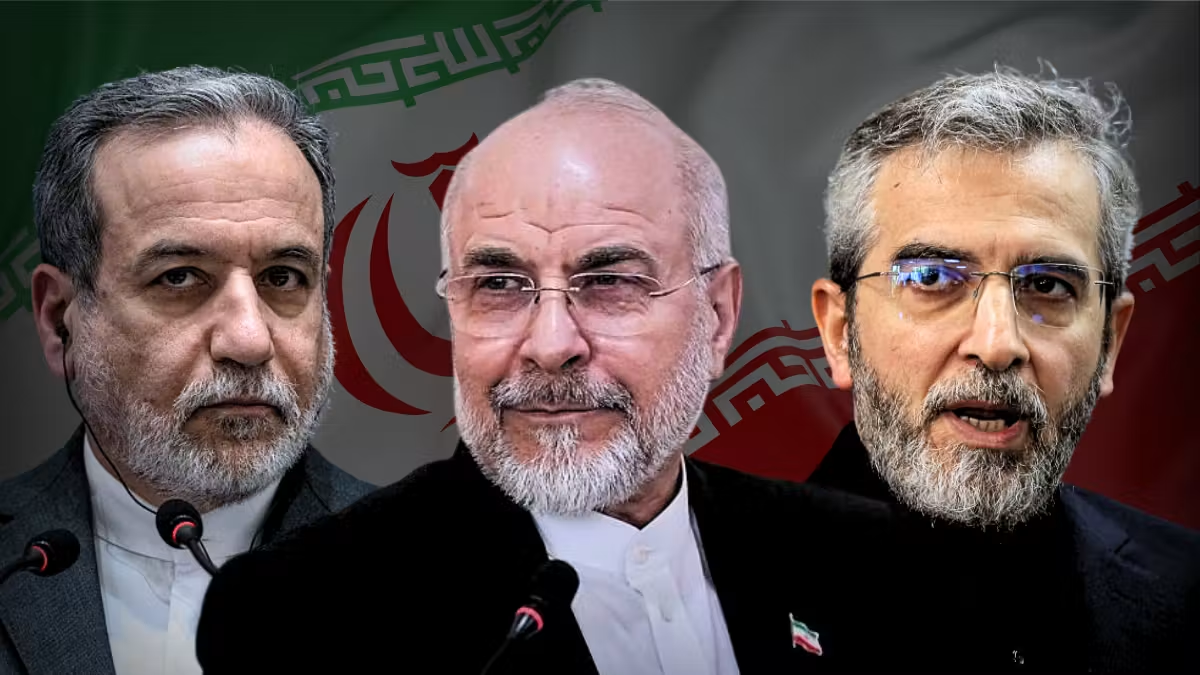
Meet The Iranians Leading Negotiations With JD Vance
As Vice President JD Vance leads negotiations aimed at ending the war against Iran and delivering on the administration’s promise that Iran would never have a nuclear weapon, one major question looms over the whole process. Can we trust Iran?
Read more Anti-Landlord Socialist Has A Family Landlord Problem
The U.S. negotiating team has signaled that Iran’s team has shown itself to be much more pragmatic than Iranian negotiators in the past. Little attention, however, has been paid to who exactly these more pragmatic Iranians are.
Iran’s delegation is not composed solely of career diplomats. The team includes former Revolutionary Guard commanders, officials tied to violent crackdowns on protesters, figures accused of human rights violations, and regime insiders linked to corruption scandals and political repression.
Their records offer a revealing look at the team helping shape the Iranian regime’s approach to the West and its response to dissent at home.
Here are the three top men representing Tehran in negotiations with the United States.
Mohammad Bagher Ghalibaf
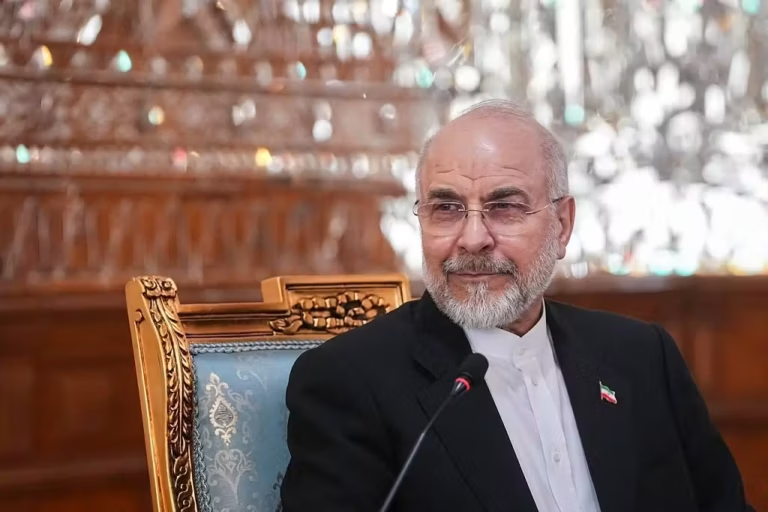
As speaker of Iran’s parliament, Mohammad Bagher Ghalibaf has emerged as one of the key figures representing Tehran in negotiations with the Trump administration.
A veteran of the U.S.-designated terror organization, the Islamic Revolutionary Guard Corps (IRGC), Ghalibaf has spent more than four decades in some of the regime’s most powerful positions, including commander of the IRGC Air Force, chief of Iran’s national police, mayor of Tehran, and, since 2020, speaker of parliament.
Across that span, Ghalibaf has faced repeated allegations of corruption and human rights abuses while earning a reputation as one of the Islamic Republic’s most prominent enforcers of violent suppression of civilian protests.
During the July 1999 student protests, he was one of 24 senior IRGC commanders who signed a letter warning then-President Mohammad Khatami that the military would intervene if his government failed to crush the demonstrations.
In a leaked 2013 audio recording, he allegedly boasted about personally assaulting student protesters, saying photographs showed him riding on the back of a motorcycle “beating them with wooden sticks,” before adding, “I was among those carrying out beatings on the street level and I am proud of that. I didn’t care I was a high ranking commander.”
He went on to describe his role in later efforts to suppress dissent, including the 2003 student demonstrations, claiming he pressured officials to authorize security forces to enter university campuses and use force against protesters.
“I went to the National Security Council meeting and raised hell, spoke very harshly. Didn’t observe proper protocol and I told them as head of the Police, I will demolish anyone who would show up tonight on the campus to protest,” he said.
Discussing the mass protests that followed Iran’s disputed 2009 presidential election, Ghalibaf boasted that Tehran’s municipality played such a significant role in suppressing the unrest that officials ranked it among the government’s top-performing institutions in responding to the protests.
“Although the Mayoralty is not a security agency, we were ranked third in how well we responded… and this is amongst intelligence-security organs, not all state organs,” he said.
The death of Mahsa Amini, a 22-year-old Iranian woman who died after being detained by Iran’s morality police for allegedly violating the country’s mandatory hijab law, sparked nationwide anti-regime protests in 2022. Ghalibaf dismissed the demonstrations as an effort to overthrow the Islamic Republic and called for those he accused of threatening public order to be dealt with harshly.
As the regime carried out a sweeping crackdown on anti-government protests in late 2025 and early 2026, with some estimates placing the death toll as high as 32,000, Ghalibaf defended the government’s response at a state-organized “Iranian Uprising Against American-Zionist Terrorism” rally. Speaking to the crowd, he portrayed the unrest as foreign-backed terrorism, arguing Iran was fighting a “war against terrorism.”
Ghalibaf has also faced repeated corruption allegations, including during his tenure as Tehran’s mayor, when his administration was accused of improperly transferring valuable municipal properties to politically connected insiders.
Years later, as Iran struggled with inflation topping 40%, he was engulfed by the 2022 “Sismonigate” scandal after members of his family were photographed returning from Turkey with luxury baby goods and nearly 20 pieces of luggage. The scandal sparked calls for his resignation. It deepened further after reports that members of his family had also purchased two luxury apartments in Istanbul worth roughly $1.6 million.
Read more Gavin Newsom Takes Coward’s Way Out On Major Left-Wing Demand
Despite four unsuccessful presidential campaigns, repeated corruption allegations, and more recent attacks from hardline lawmakers over negotiations with the United States, Ghalibaf has remained one of the Islamic Republic’s most influential political figures. His critics have accused him of shielding the negotiations from parliamentary scrutiny and crossing Supreme Leader Mojtaba Khamenei’s red lines, reported Iran International.
Abbas Araghchi
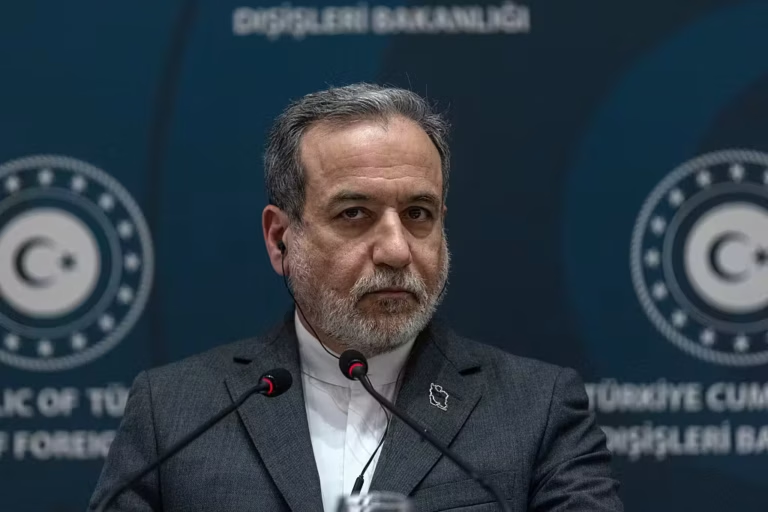
As Iran’s foreign minister and one of the regime’s longest-serving nuclear negotiators, Abbas Araghchi has become the face of Tehran’s diplomacy with the West.
Araghchi has spent more than two decades climbing the ranks in the Islamic regime. After earning a Ph.D. from England’s University of Kent, he served as Iran’s ambassador to Finland and Japan, Foreign Ministry spokesman, deputy foreign minister, chief nuclear negotiator, and, in 2024, foreign minister.
To Western audiences, Araghchi is often viewed as a seasoned diplomat. But before entering the Foreign Ministry, he spent nine years serving in the IRGC during the Iran-Iraq War.
The IRGC remains one of the most powerful pillars of the Islamic Republic and has long been accused of supporting terrorism abroad and brutally suppressing dissent at home.
Araghchi has consistently defended the regime’s hardline positions toward the United States and its allies. Following U.S. strikes on Iranian nuclear facilities in 2025, he accused Washington of committing “a grave violation of the UN Charter, international law and the NPT” and warned the attacks would have “everlasting consequences.”
Araghchi has also brushed off Western criticism of the regime’s human rights record. In 2023, amid global demonstrations supporting Iran’s protest movement following the death of Mahsa Amini, Araghchi urged Iranian officials to prevent demonstrations against the Islamic Republic from taking place abroad. He argued the protests were fueling an effort to “defame and delegitimize” the regime and warned the campaign was “very dangerous” because it was harming Iran’s relationships with other countries.
During the regime’s squashing of the protests in January 2026, German Chancellor Friedrich Merz accused Tehran of using “disproportionate and brutal violence” against demonstrators. Araghchi dismissed the criticism, arguing Germany had forfeited its credibility on human rights because of its support for Israel’s war in Gaza.
Ali Bagheri Kani
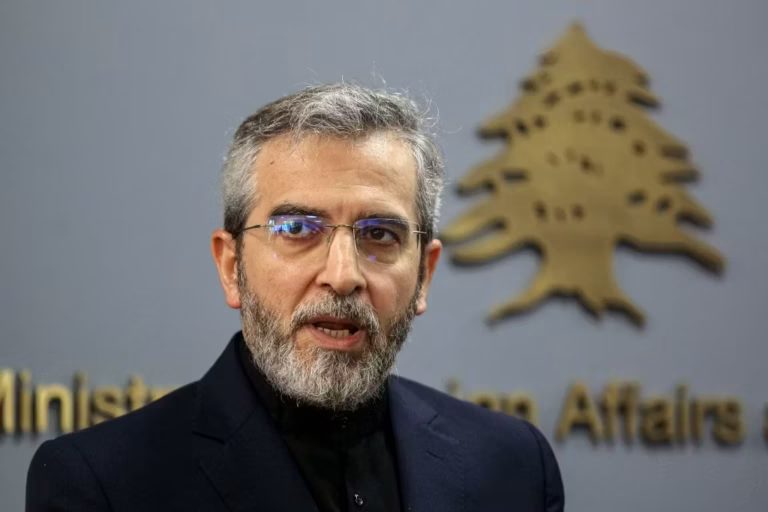
Another key figure in Iran’s delegation is Ali Bagheri Kani, deputy secretary of Iran’s Supreme National Security Council and a longtime regime insider whose career has taken him through Iran’s security establishment, judiciary, and nuclear negotiating team.
Bagheri Kani’s rise through the Islamic Republic has been closely intertwined with one of the regime’s most influential political families. His father, Mohammad-Bagher Bagheri Kani, is a prominent cleric and former member of parliament and the Assembly of Experts. His uncle, Mohammad Reza Mahdavi Kani, served as acting prime minister, interior minister, and later chaired the Assembly of Experts. His brother is married to a daughter of former Supreme Leader Ayatollah Ali Khamenei, according to Al Jazeera.
He served as deputy foreign minister for political affairs and briefly as acting foreign minister after Foreign Minister Hossein Amirabdollahian was killed in a 2024 helicopter crash.
He also held senior positions in Iran’s judiciary, serving as deputy for international affairs and secretary of the regime’s Human Rights Headquarters, which is responsible for defending Iran’s human rights record on the international stage.
He also worked under hardline negotiator Saeed Jalili from 2007 to 2013, when the Supreme National Security Council handled the country’s nuclear file. Bagheri Kani managed Jalili’s 2013 presidential campaign, defending his confrontational approach to negotiations while opposing then-candidate Hassan Rouhani’s push for a nuclear agreement with the West. He later defended Iran’s strategy of stalling negotiations, saying Tehran deliberately sought to “buy time” so work at the Fordow and Arak nuclear facilities could continue.
After Rouhani took office and pursued President Barack Obama’s 2015 nuclear deal with Iran, formally known as the Joint Comprehensive Plan of Action (JCPOA), Bagheri Kani became one of its most outspoken critics. He repeatedly attacked the negotiations in parliament, wrote op-eds condemning the agreement, and argued it was a Western trap that surrendered Iran’s sovereignty. He later described Iran’s negotiations with the United States as “a bitter historical experience.”
In 2021, he became Tehran’s chief nuclear negotiator and led the Vienna talks aimed at reviving the very agreement he had spent years opposing.
Bagheri Kani has consistently taken a hard line against the United States. He denounced what he called Washington’s “unlawful and inhumane sanctions,” argued in July 2024 that the U.S. “cannot be part of the solution” in the Middle East but is instead “the main obstacle,” and, in June, he accused Washington of seeking to “destroy Iran’s civilisation, capabilities, and self-confidence.”
Read more U.S. Attacks Iran After Regime Breaks Ceasefire
Leona Salinas contributed to this report.










Post Comment