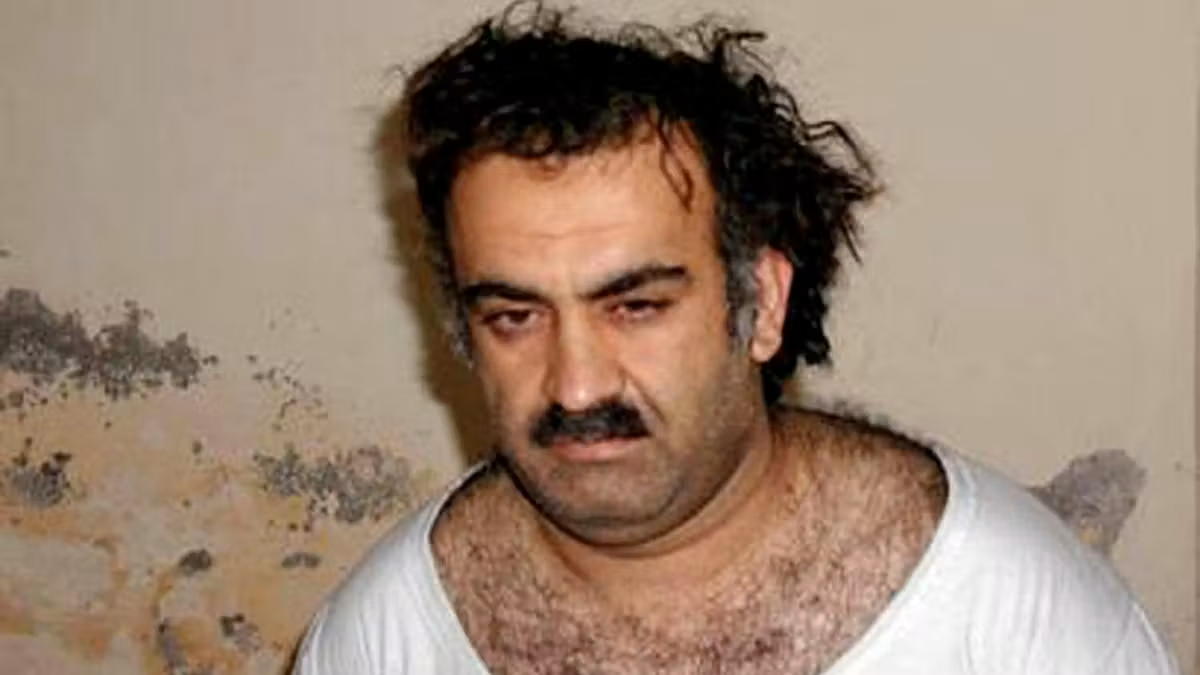
Judge Who Tossed Confession For 9/11 Mastermind Outed As Left-Wing Ideologue
The military judge overseeing the long-delayed prosecution of 9/11 mastermind Khalid Sheikh Mohammed recently threw out the terrorist’s confession to FBI agents, dealing a major blow to the government’s case. Now, the judge’s writings have come under scrutiny for his criticism of conservatives in the military.
Read more Iran’s Execution Spree: 10 Young Activists Condemned To Death In Sham Isfahan Trial
Lt. Colonel Michael Schrama, an Air Force judge presiding over the military commission at Guantanamo Bay, ruled Friday that statements Mohammed made to FBI agents in 2007 were not given voluntarily and could not be used against him at trial. The ruling came just days after Schrama set June 5, 2028, as the start date for Mohammed’s trial, nearly 27 years after the September 11 terrorist attacks that killed nearly 3,000 Americans.
Mohammed had previously been subjected to CIA interrogations, including 183 instances of waterboarding, after his capture in 2003. Prosecutors had already excluded statements from those interrogations. Schrama went further, finding that the effects of the earlier interrogation continued to influence Mohammed when he was questioned by FBI agents at Guantanamo in 2007.
But scrutiny of the judge has also revived a 2023 essay in which Schrama argued that the military needed new legal tools to combat what he described as a growing domestic extremism which he attributed to the military’s “conservative tendencies.”
“As an active-duty Air Force military judge, I have seen firsthand a rising population of military members engaging in extremist activities,” Schrama wrote in the essay. Schrama argued that “military institutions tend to become more conservative and isolated from civilian society.”
“These conservative tendencies are constantly reinforced, and young military members can be easy prey for the extreme right-wing groups that relate through similar conservative ideology,” he wrote. He called domestic extremism in the military “a threat to national security” and argued that Congress should create a specific offense under the Uniform Code of Military Justice to allow commanders to punish such conduct.
The essay also discussed Coast Guard Lt. Christopher Hasson, who pleaded guilty in 2019 to gun and drug charges after prosecutors alleged he had stockpiled weapons and planned to murder Democratic politicians, Supreme Court justices, and journalists. Schrama argued that the case demonstrated the limitations of existing federal law because prosecutors had charged Hasson with other offenses rather than a specific domestic terrorism crime.
The essay was not written in Schrama’s capacity as a judge on the military commissions. Schrama’s ruling on Mohammed’s confession is nevertheless likely to have significant consequences for a case that has been stuck in pretrial proceedings for nearly two decades.
“The prosecution has failed to prove by a preponderance of the evidence that Mr. Mohammad’s statements to the F.B.I. were voluntarily given,” Schrama wrote, according to the ruling’s conclusion.
Read more Tony Romo Comes Clean In Brutally Candid Letter
The judge found that Mohammed’s treatment by the CIA had created an “unbroken continuation of the CIA’s psychological conditioning and severe coercion” that carried over into his later questioning. He also found that FBI agents failed to explicitly tell Mohammed that he had a right to remain silent and consult an attorney.
The government has five days to decide whether to appeal the ruling, with the option to request another five days. Rear Admiral Aaron C. Rugh, the chief prosecutor, said the government would review the decision before determining whether to appeal.
Without Mohammed’s FBI confessions, prosecutors will have to rely on other evidence, including documents, telephone intercepts, and transcripts of other conversations. Some of that evidence has also been challenged in the years of litigation surrounding the case.
The confession was particularly important because Mohammed is accused of developing the 9/11 plot in the 1990s, pitching it to Osama bin Laden and helping select and train the hijackers who ultimately carried out the attacks. The case has already survived repeated delays and changes in judges. Schrama became the fifth judge assigned to oversee the prosecution in 2025.
White House senior adviser Stephen Miller blasted the decision, saying the American judicial system is “so badly broken it sides at every turn with predators, monsters and, in this case, a 9/11 mastermind.”
“It’s a disgrace, it’s a travesty, it’s an outrage,” Miller said.
Mohammed’s defense attorneys, meanwhile, have argued that his years of torture, isolation, and coercive treatment made his later statements to FBI agents involuntary. Gary Sowards, one of Mohammed’s attorneys, said the ruling demonstrated “why the government shouldn’t engage in such shameful conduct.”
For the families of the September 11 victims, however, the latest development represents another setback in a prosecution that has been delayed for years — and now prosecutors have to fight to restore one of the most important pieces of evidence in their case.
Read more Top Bank Executive Killed In Times Square Stabbing Spree










Post Comment