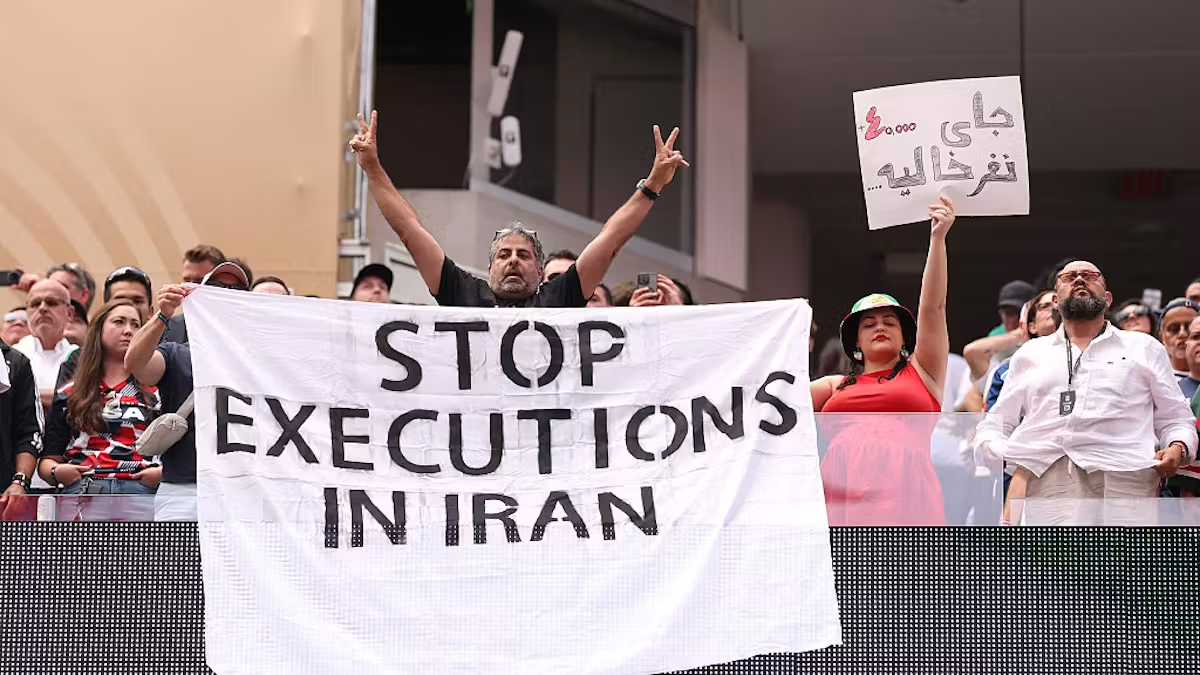
The Chilling Message Sent To Anyone Who Dares Speak Out
Just before dawn on Tuesday, hundreds of Iranians gathered in Isfahan hoping to stop two young men from being hanged. Instead, security forces violently dispersed the crowd and publicly executed 25-year-old Abolfazl Sepahi Badjani and 28-year-old Amirhossein Safari Hosseinabadi.
Read more After Fauci Pleads The Fifth, Rand Paul Makes Contempt Move
Both men were convicted on charges stemming from clashes that Iranian authorities say resulted in the deaths of four security officers. Human rights groups say the men were sentenced after proceedings marred by allegations of torture, forced confessions, and closed-door trials.
The executions stem from the nationwide uprising that began in late December after a currency collapse, soaring inflation, and worsening living conditions sparked protests across Iran. Iranian regime forces responded with a sweeping crackdown that included internet shutdowns, mass arrests, and the widespread use of lethal force.
The executions, which reportedly took place at 3:40 a.m. local time, coinciding with the morning call to prayer, came despite last-minute appeals from United Nations experts, international human rights organizations, and the State Department.
Days before the hangings, State Department Assistant Secretary of State for Democracy, Human Rights, and Labor Riley Barnes condemned Iran’s execution campaign, saying the United States stood with “brave young Iranians who dared to raise their voices” and calling on the regime to release political prisoners and stop executing individuals for peacefully exercising their fundamental rights.
President Donald Trump has continued to call out the treatment of protesters and the executions, including last week, when he shared a graphic about the execution of another January protester, 23-year-old Gol-Mohammad Mohammadi.
“The latest one of 52,000, plus, innocent protesters. Savages!!! When will the Dumocrats wake up??? Trump posted.
Human rights groups have not verified Trump’s figure of 52,000 protesters killed, though Amnesty International and U.N. officials have estimated that several thousand were killed during the regime’s January crackdown. Iran has acknowledged that 3,117 people were killed.
Rather than silencing dissent, the executions appeared to galvanize it for the first time since January.
Videos posted by Radio Free Europe showed crowds gathering in Isfahan to demonstrate during the executions, with demonstrators chanting “Without honor!” while security forces maintained a heavy presence.
Iranian Demonstrators Protest State Executions In Isfahan
Videos posted on social media appeared to show crowds of protesters gathering in Isfahan on July 28 to demonstrate as state executions of two men took place.
With more executions feared, the videos show groups of people… pic.twitter.com/6U550mm6od
— Radio Free Europe/Radio Liberty (@RFERL) July 28, 2026
Videos shared by Iran International showed residents gathering overnight in hopes of stopping the executions before authorities dispersed the crowd.
Messages sent to Iran International from Bandar Abbas, Pardis, Khomein, and other cities described a country grieving but increasingly determined to continue resisting the Islamic Republic. Many said they stayed awake until morning hoping the executions would be called off.
“We wished until sunrise that morning would never come to Isfahan,” one person wrote.
“The people of Isfahan showed that when the next call comes, millions across the country will return to the streets,” one resident of Bandar Abbas said.
Read more Senator Scorned By Trump Threatens To Hold AG Nominee Hostage Over Weaponization Fund
Another reaction shared by the outlet echoed that sentiment: “Did you think executing our brothers and sisters would make us retreat or become afraid? It has only made us more determined.”
The two men were among 12 defendants sentenced to death in what has become known as the Alikhani Square case, which stems from the January anti-government protests in Isfahan. They are reportedly accused of arson, vandalism, killing four security personnel, and “waging war on God.”
According to the Oslo-based Iran Human Rights (IHRNGO) organization, 62 people were initially arrested in connection with the incident and subjected to months of interrogation, during which rights groups allege many were tortured.
Ahead of the executions, U.N. experts led by Special Rapporteur Mai Sato urged Iranian authorities to halt the executions and claimed sentencing all 12 defendants to death in a single closed-door proceeding violated internationally recognized fair trial standards. The experts said the convictions relied heavily on televised confessions, while hearings were held behind closed doors and judgments were never made public.
IHRNGO also alleged that some defendants were tried remotely from prison without lawyers present and that Iranian state television later aired forced confessions as part of a propaganda documentary. The organization also says families of death row prisoners are routinely threatened and coerced into remaining silent about their loved ones’ cases.
According to IHRNGO, at least 26 protesters have been executed in connection with the December 2025–January 2026 uprising, including Sepahi and Safari, and more than 70 additional protesters remain at risk of execution in Isfahan’s Dastgerd Central Prison.
Even behind prison walls, resistance has continued. Hundreds of death row inmates at Ghezel Hesar Prison near Tehran have joined a mass hunger strike to protest Iran’s escalating use of the death penalty, reported The Guardian. According to Iranian rights groups, at least 1,500 prisoners have participated in the strike, which began after six men convicted on drug-related charges were transferred to solitary confinement ahead of possible executions.
Videos shared by rights groups show prisoners holding signs reading “No to Executions” and chanting, “Be our voice.”
In one video, a prisoner is seen sewing his lips shut after he said prison officials ignored the protest for days.
According to IHRNGO, at least 424 people have been executed in Iran so far this year. The organization documented 795 executions in 2025, the highest annual total in years.
While many of those executions involved drug-related offenses, rights groups say the Islamic Republic has increasingly used capital punishment against political dissidents and protesters in the months following the January anti-government uprising, with many convictions allegedly secured through torture and forced confessions.
Iran Human Rights Director Mahmood Amiry-Moghaddam condemned Tuesday’s hangings, calling public executions “a cruel form of state terror” intended to instill fear and deter future protests.
“By resorting once again to the medieval practice of public hangings, the Islamic Republic is trying to instill fear throughout society and deter future protests,” Amiry-Moghaddam said. “Public executions are a cruel form of state terror that the international community must not tolerate.”
Amnesty International warned that the international community’s failure to hold Tehran accountable for its crackdown risks emboldening further abuses.
“The international community’s failure to pursue international justice for these serious crimes has emboldened the Iranian authorities to threaten further mass killings by ‘trigger-ready’ security forces targeting protesters and dissidents they label as ‘enemies.’” Diana Eltahawy, Deputy Regional Director for the Middle East and North Africa at Amnesty International, said.
Read more Inside WPATH: Trans Surgeon Admits Patients May Experience Painful Complications










Post Comment